
Stylish Alternatives to Cover Bands for Events

A packed dancefloor is not the only measure of a great event. At a drinks reception, gala dinner or beautifully considered wedding, the music needs to do more than fill silence. It needs to set the temperature of the room. That is why stylish alternatives to cover bands are increasingly the first choice for hosts who want familiar songs without the standard function-band formula.
The right act can make guests feel immediately at ease, give a venue character and keep conversation flowing - then lift the energy when the occasion calls for it. Think current hits and all-time favourites recast with soul, swing and a little old-school sparkle. It is recognisable music, but with better tailoring.
Why the standard cover-band format does not suit every event
A conventional cover band has a clear role. For a late-night party, a big singalong set and a full dancefloor, it can be exactly right. But a five-piece band playing loud, faithful versions of rock and pop classics is not automatically the best fit for every stage of an event.
For corporate receptions, wedding breakfasts, networking evenings and private dinners, volume and visual footprint matter. Guests may be meeting clients, reconnecting with family or moving between the bar, terrace and dining room. Music should bring life to those moments, not compete with them.
There is also the question of personality. Standard cover-band set lists can feel interchangeable: the same arrangements, the same costume choices, the same predictable build towards the final chorus. A more curated live act gives an event its own musical point of view. It says the entertainment was chosen, not simply booked.
That does not mean sacrificing crowd appeal. Quite the opposite. The strongest alternatives understand the value of a song everyone knows. Their skill lies in changing the frame around it - turning a modern pop anthem into a smoky jazz number, a 1990s favourite into a soulful groove, or an 1980s hit into something with cocktail-hour cool.
What makes stylish alternatives to cover bands work
The appeal is in the contrast. Guests recognise the melody, perhaps before they have even placed the arrangement. That moment of recognition creates an instant connection, while the unexpected style gives the performance a sense of occasion.
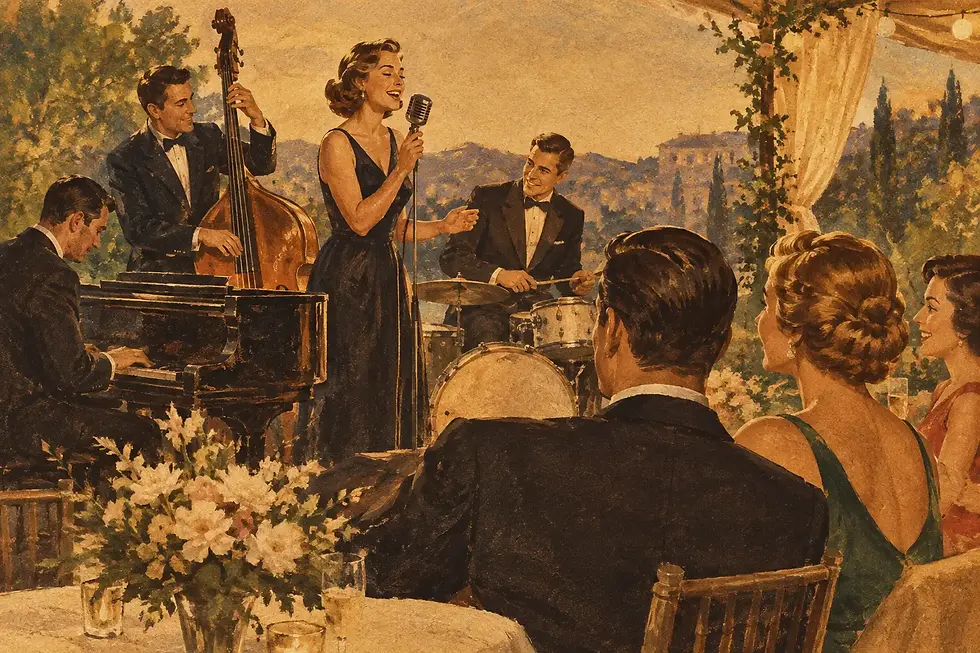
A compact vintage-inspired quartet is a particularly effective format. Double bass, drums, piano and powerhouse vocals offer warmth, rhythm and real visual character without swallowing the room. The sound can sit elegantly in a corner of a reception space, yet still carry a feature set when it is time to gather everyone’s attention.
This combination is useful because event music has to work across changing moods. Early arrivals need something welcoming. Drinks receptions need polish and pace. Dinner calls for restraint. Later in the evening, the room may be ready for bigger vocals, more rhythm and songs that pull people towards the dancefloor. A versatile act can shape the set around the event rather than forcing the event around a fixed show.
The aesthetic matters too. A vintage look and sound should feel intentional, not novelty. The goal is not a costume-party imitation of another era. It is contemporary entertainment with a timeless finish: new tunes, old-style. When the arrangements are sharp and the performers experienced, the result feels lively rather than retro for retro’s sake.
The best options for different moments
There is no single replacement for a cover band because no two events have the same brief. The most suitable choice depends on guest numbers, venue acoustics, the point in the schedule and the kind of atmosphere you want people to remember.
A vintage-style party quartet
For hosts who want the familiarity of popular music with more character, a vintage-style quartet is hard to beat. It can move comfortably through jazz, soul, blues and pop, translating well-known songs into arrangements that feel sophisticated, playful and fresh.
This format suits drinks receptions, wedding celebrations, awards evenings, brand launches and private parties particularly well. It creates a genuine live experience rather than background playlist energy, while remaining elegant enough for guests to talk, mingle and enjoy the setting.
It is also a strong practical choice. A small footprint is easier to accommodate in a boutique hotel, a private dining room, a gallery or the corner of a larger event space. Less stage clutter can make a substantial difference to the look and flow of a room.
A jazz or soul-led ensemble
A jazz or soul ensemble can bring class to a reception, especially where the brief is refined and low-key. This is a good option for champagne arrivals, networking events and seated dinners where the music is there to enhance the occasion rather than lead it.
The trade-off is repertoire. A traditional jazz group may not give guests the immediate familiarity of modern pop songs, while a soul outfit may lean into a particular era or energy level. If recognisable cross-generational material is central to the brief, look for musicians who can blend the classics with clever takes on newer tracks.
An acoustic duo or trio
Smaller acoustic line-ups are ideal for intimate celebrations and venues with tight sound limits. They offer warmth, simplicity and a personal feel, whether the setting is a garden ceremony, a restaurant lunch or a small private party.
They may not, however, have the rhythmic drive or visual impact needed for a large corporate room or a late-night celebration. An acoustic format is at its best when intimacy is the point, not when it is being asked to perform like a full-scale party act.
A DJ paired with live musicians
A DJ and live vocalist, saxophonist or percussionist can be a strong choice for a later, more club-focused finish. It offers a broad catalogue and keeps the energy high without pauses between songs.
For a whole event, though, this approach can be less suited to relaxed conversation-led moments. It often works best as a second act after dinner, or alongside an earlier live band that has already established a more welcoming, human atmosphere.
How to choose an act that fits the room
Start with the room before the repertoire. A grand ballroom, a rooftop terrace and a converted barn each ask different things of live music. Consider where the performers will sit or stand, whether guests will be circulating, what sound restrictions apply and how close the entertainment is to food service or speeches.
Then think about the guest list. A room of colleagues, clients and senior stakeholders may need a confident but measured soundtrack. A wedding with several generations needs songs that land across ages without becoming cheesy. A birthday party may want more edge and surprise. Stylish does not mean restrained at all costs - it means appropriate, well judged and memorable.
Ask prospective performers how they approach pacing. The best event musicians do not merely arrive with a set list. They read the room, understand the schedule and know when to hold back. They can provide a polished backdrop during the first hour, then build naturally as guests relax.
It is worth asking about breaks, production requirements and contingency planning as well. Premium entertainment should feel effortless to guests because it has been carefully organised behind the scenes. Professionalism is part of the performance, from punctual load-in to sensible sound levels and clear coordination with planners and venues.
Familiar songs deserve a better arrangement
There is a reason the greatest pop songs endure: people carry them with them. The right live act respects that connection while offering something a playlist or predictable cover set cannot. A reworked song can make guests lean in, laugh in recognition or hear an old favourite with fresh ears.
That is the space where Vintage Boombox performs best: contemporary and nostalgic songs, reimagined with double bass, drums, piano and big, expressive vocals. The sound is built for occasions that want atmosphere first, with enough energy to make the room move when the moment arrives.
For event planners, that balance is valuable. You are not choosing between tasteful and entertaining, nor between background music and a headline moment. You are choosing an act with the musical range to deliver both.
When the last guest remembers the evening, they may not recall every table setting or canapé. They will remember how the room felt. Choose music with character, and that feeling stays with them long after the final note.


Comments