
How to Choose Event Musicians With Style

A great event can look immaculate on paper, then feel oddly flat once guests arrive. The difference is often the music. When you choose event musicians, you are not simply booking a set of songs. You are choosing the pace of the room, the confidence of the welcome and the memory guests take home after the last glass is cleared.
For a corporate reception, wedding breakfast or private party, the strongest choice is rarely the loudest act or the biggest line-up. It is the one that understands its role: bringing character, warmth and familiar tunes to the occasion without competing with the conversations that matter.
Start with the feeling, not the genre
Before comparing bands, decide what you want guests to feel in the first half-hour. A drinks reception might need a stylish lift after a formal arrival. A brunch may call for something sunny and sociable. A product launch may need a sharper sense of occasion, while an evening party can gradually build towards a more energetic performance.
This is more useful than starting with a broad label such as jazz, pop or soul. Genres describe musical ingredients, but atmosphere is what guests actually notice. Ask yourself whether the room should feel relaxed, glamorous, playful, celebratory or quietly impressive. The answer will quickly rule out acts that are technically excellent but wrong for the moment.
Familiar music often works best because it gives a mixed-age room an immediate point of connection. The clever part is presentation. A well-arranged vintage take on a modern favourite can feel more distinctive than a standard copy of the original, while still giving guests that instant recognition. New tunes, old-style is not a novelty when it is done with taste - it is a way to make a playlist feel curated for the room.
Choose event musicians for the room you actually have
Venue photographs can be deceptive. A ballroom may have an elegant performance corner but restricted loading access. A private dining room may be beautiful and intimate, yet leave little space once tables, flowers and a bar are in place. Before committing, share the practical details with the act: dimensions, stage position, access route, parking, sound limitations and the schedule for supplier set-up.
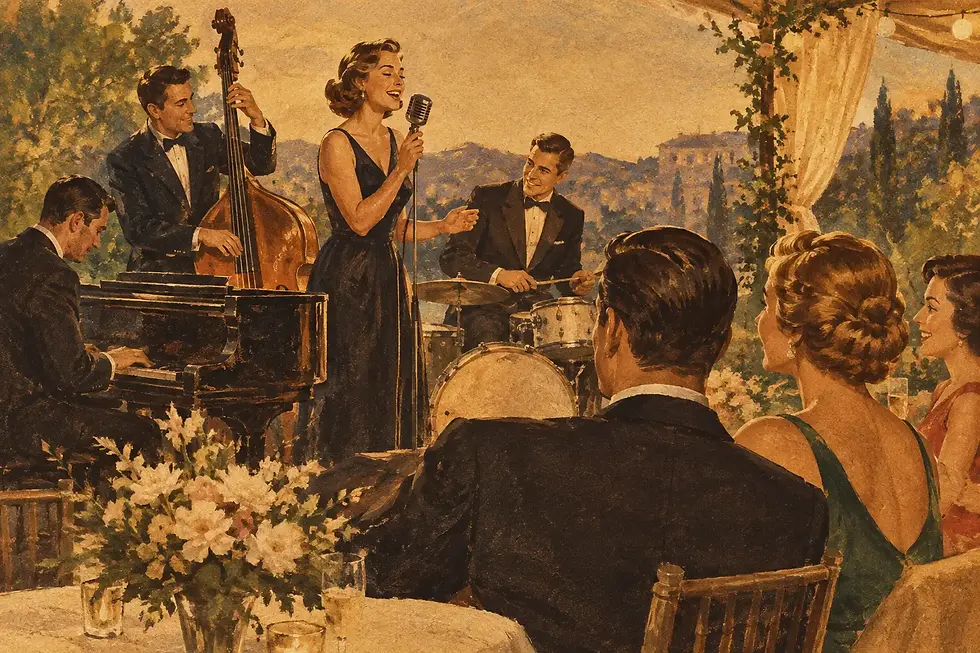
A compact line-up has a genuine advantage here. A quartet built around vocals, piano, double bass and drums can create a full, lively sound without turning a drinks reception into a festival stage. It also has visual presence. Instruments, smart staging and a considered look add to the event design rather than appearing as an afterthought in the corner.
Smaller does not automatically mean quieter, and bigger does not always mean better. A full party band may be perfect for a late-night dancefloor in a large venue. For an afternoon reception where guests need to mingle, a polished small ensemble is often the more luxurious choice. The measure is whether the music fills the space without swallowing it.
Ask about volume in real terms
“Background music” means different things to different people. Tell the musicians whether guests should comfortably chat beside the performance area, whether speeches are planned nearby and whether the venue has a sound limiter. Ask how they adjust levels across the day, not simply whether they can play quietly.
Experienced event musicians know that volume is part of the performance. They can begin with a light, conversational set, then raise the energy when the room is ready. That control is far more valuable than a one-speed show.
Look beyond the set list
A set list matters, but it is only the visible part of the booking. Two acts may both play soul, pop and 1980s classics, yet offer completely different experiences. Listen for arrangements, vocal style, musical character and how naturally the repertoire moves between eras.
The best event sets have shape. They allow guests to settle in, introduce familiar moments at the right time and leave room for the event itself. A band should not play every recognisable chorus back-to-back from the opening note. Nor should it disappear so completely that the atmosphere never lifts.
Ask for examples that match your event rather than requesting an enormous catalogue. For a sophisticated reception, you might want contemporary pop recast with swing, blues or jazz colour, followed by soul favourites that keep the room buoyant. For a party, the same musicians may deliver more pace and punch later on. Versatility is not about trying to be every kind of act. It is about making one clear musical identity work across the day.
There is also a trade-off with requests. A personal song can be a lovely touch, particularly for a wedding or milestone celebration, but it should suit the act's sound. Musicians will give their best performance when the request sits naturally within their instrumentation and style. A tasteful arrangement is more memorable than a reluctant imitation.
Prioritise event experience, not just musical talent
A brilliant singer or instrumentalist is not automatically a brilliant event performer. Live events run to their own rhythm. Guests arrive late. Speeches overrun. A photographer needs five more minutes. Catering staff need access. The right musicians handle these changes calmly and keep the mood intact.
When considering an act, look for evidence of real-world event experience. Do they understand how to arrive, set up and soundcheck discreetly? Can they coordinate with a planner, venue manager or toastmaster? Are they comfortable performing for a room of senior colleagues one week and a lively wedding crowd the next?
Professionalism is felt long before the first song. Clear timings, sensible technical questions and straightforward communication are reassuring signs. So is an act that asks about the order of the day. They are not being difficult; they are working out how to make their performance land properly.
Vintage Boombox was built for exactly this balance: a small-footprint quartet with a bold musical identity, designed to add polish at a reception and deliver a featured performance when the occasion calls for it.
Match the performance to the event timeline
Music should serve the transitions. During arrivals, it can soften the awkwardness of early mingling. Over drinks, it creates momentum without making conversation hard work. Between formal moments, it prevents a pause from feeling like a lull. Later, it can signal that the event is shifting from polished hosting to proper celebration.
Discuss the performance format early. One longer set may suit a focused evening showcase. Two sets with a break can work better for a reception and dinner arrangement. Shorter appearances can be effective for a brand moment, awards entrance or surprise feature, provided there is enough time to set up properly.
Do not overlook breaks. Ask what happens musically when the band is offstage and whether background playback is available or needed. This small detail helps the room retain its energy. Equally, make sure the act has realistic time for arrival, set-up and soundcheck. Rushing musicians through a technical set-up is not the route to a refined result.
Consider your guests, without trying to please everyone
A mixed room does not require a lowest-common-denominator playlist. It needs recognisable material, smartly chosen and played with personality. Older guests may enjoy the vintage flavour; younger guests may delight in recognising a current track in an unexpected arrangement. The shared reaction is often the point.
Think about who will be listening at each stage. At a corporate event, clients, colleagues and leadership teams may all be present. At a wedding, the early part of the day may span grandparents, friends and children, while the evening takes a different turn. Good musicians read the changing room rather than treating every booking as the same party.
That said, be honest about your priority. If you want a sophisticated social soundtrack, do not book a high-volume dance act and ask it to become background ambience. If the aim is a packed dancefloor until midnight, make that clear from the start. The best bookings happen when the brief and the act genuinely fit.
Questions worth asking before you book
Before paying a deposit, confirm the essentials in writing. Ask about the exact line-up, performance duration, set-up time, space and power requirements, sound limits, public liability cover, cancellation terms and what is included in the fee. If your schedule is still moving, explain that too and ask how timing changes are managed.
It is also worth asking who will be your point of contact on the day. For larger events, musicians should know whether to speak to the planner, venue coordinator or organiser. A simple chain of communication keeps little decisions from becoming last-minute distractions.
The final test is easy: can you picture the act in your event, not just in a promotional video? Imagine guests arriving, glasses clinking, conversations starting and a familiar melody given a fresh, elegant twist. If the music makes that picture stronger, you are close to the right choice.
Choose musicians who bring more than songs. Choose the people who understand the room, respect the running order and know exactly when to let a great tune do the talking.


Comments