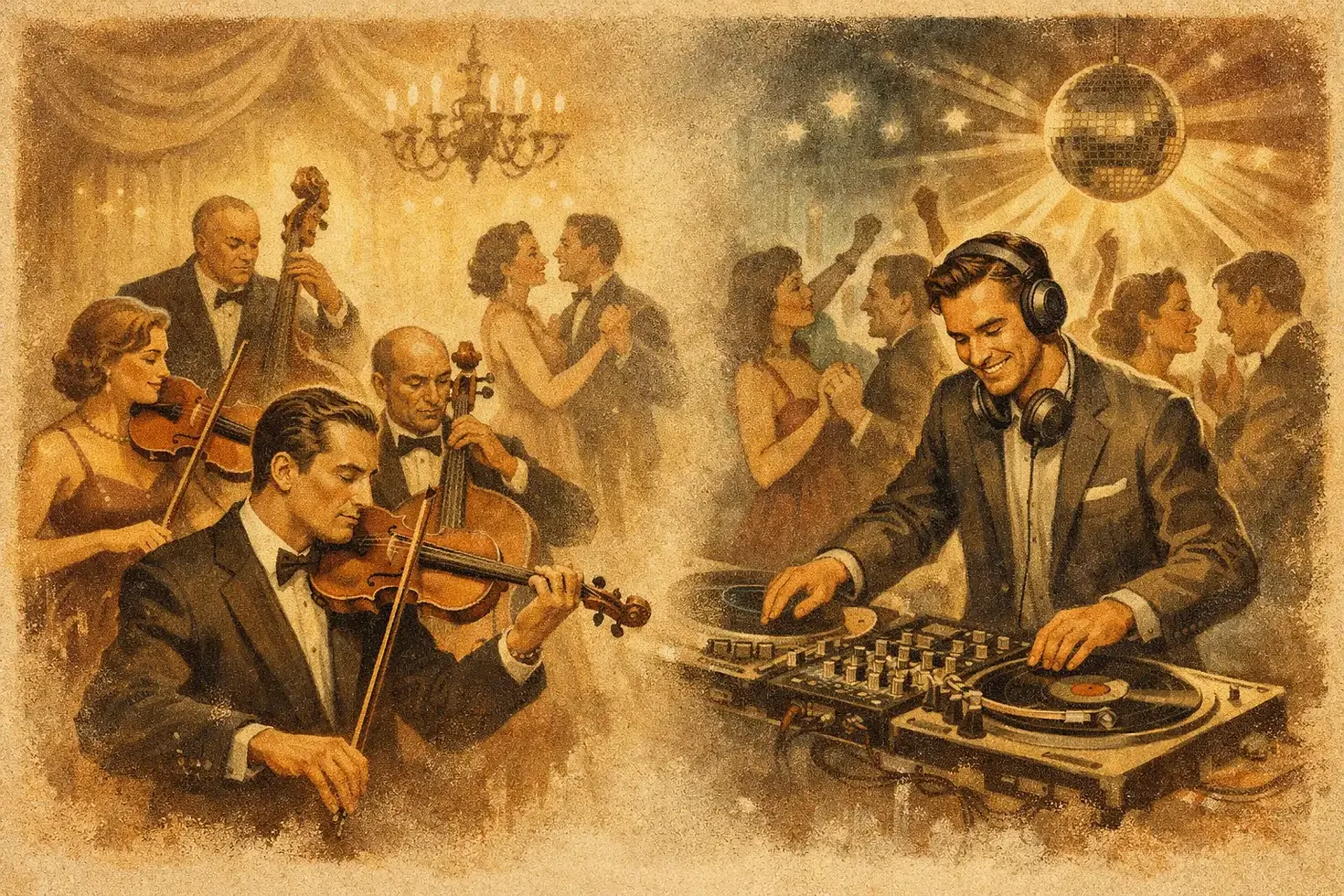
Quartet vs DJ Reception: Which Fits Best?
- Cormac Moore
- Jun 6
- 6 min read

The room tells you the answer before the playlist does. If your reception needs warmth, conversation and a sense of occasion from the first glass poured, the quartet vs dj reception question is less about volume and more about atmosphere.
A reception is not a nightclub at 11pm. It is the part of an event where guests arrive, read the room and decide how the occasion feels. That makes your music choice a genuine design decision, not a finishing touch. Get it right and the whole event feels considered. Get it wrong and even a beautiful venue can feel oddly flat.
Quartet vs DJ reception - the real difference
A DJ is usually the practical shorthand for variety, convenience and dancing later on. A quartet brings presence, texture and a stronger sense of live occasion. Neither is automatically better. The right choice depends on what the reception is supposed to do.
For drinks receptions, corporate welcomes, stylish wedding afternoons and private parties where people still want to speak to one another, a live quartet often changes the room in a way recorded music simply does not. Guests do not just hear it. They clock it. The double bass, the piano, the vocal, the visual character of the group - it all contributes to the event feeling hosted rather than merely soundtracked.
A DJ, by contrast, is brilliantly effective when you want a broad catalogue on demand, sharper transitions between eras and the option to move from background music to a fuller dancefloor set with minimal fuss. If your reception is short, your brief is broad and you want maximum song familiarity at a lower production footprint, that can be a smart route.
Start with the mood, not the format
The quickest way to decide between quartet vs dj reception options is to ask what you want guests to feel in the first 30 minutes.
If the answer is polished, welcoming, sociable and elevated, live music has a natural advantage. A quartet can shape the energy without dominating it. The music breathes with the room. It can sit behind conversation when guests are settling in, then lean in a touch as confidence builds.
If the answer is upbeat, immediate and playlist-led, a DJ may fit more naturally. There is less visual theatre, but there is instant access to familiar tracks in their original form. Some clients want exactly that - recognisable songs with no reinterpretation, no pause between selections and no live set structure.
That distinction matters. A reception usually benefits from music with nuance. It needs to support the event, not rush it. Live musicians are often better at reading those subtle shifts because they are doing it in real time.
Why a quartet often wins for receptions
A quartet is particularly strong when style matters as much as entertainment. In premium venues, on terraces, in hotel lounges, under marquees and in gallery spaces, a compact live band adds visual polish without the heavy footprint of a larger function act.
That is one of the reasons a small-footprint live group works so well for sophisticated events. You get the character of live performance without sacrificing floor space, table layout or guest flow. It feels curated rather than cumbersome.
There is also the question of repertoire. A good quartet does not need to sound niche. Familiar pop, soul and party classics, reworked with charm and musicality, can feel fresher than hearing the exact same radio mix guests have heard for years. That is where a vintage-style arrangement can be especially effective - well-known songs, but with more style, more texture and more personality.
For weddings, that can make the drinks reception feel distinct from the evening party. For corporate events, it can lift the brand impression. For private hosts, it signals taste without trying too hard.
Where a DJ has the edge
This is not a case of live music always winning. A DJ offers real advantages.
First, there is scale of catalogue. If your guest list spans several generations and you want everything from Motown to 2000s club tracks to current chart favourites, a DJ can cover that with ease. Second, there is continuity. No set breaks, no change in instrumentation, no reinterpretation. Third, there is budget efficiency. For some events, that flexibility matters more than the live element.
A DJ can also be ideal if the reception is only a bridge to the party. If guests are arriving, having one drink and moving swiftly into a dance-led format, a separate live reception act may feel unnecessary. In that scenario, one supplier handling both background music and the later dancefloor can make logistical sense.
The point is not that a DJ is the cheaper compromise. In the right event, it is the correct creative choice. The question is whether your reception needs a selector or a performance.
Space, sound and guest flow
One of the biggest misconceptions in the quartet vs dj reception debate is that live music automatically means more volume, more equipment and more disruption. A well-run quartet is often surprisingly discreet in practical terms.
A compact line-up can fit into corners, alcoves and reception areas that would not suit a larger band. Setup is usually straightforward, and the sound can be controlled with care. That matters for venues where speeches, service and conversation all need room to breathe.
A DJ setup can of course be compact too, but the visual impact is different. Even a clean, professional DJ booth reads as production. A quartet reads as occasion. If your event design leans towards candles, florals, polished glassware and a strong sense of hospitality, live players often sit more naturally within that picture.
Guest flow matters as well. Receptions are rarely static. People arrive in waves, move between bar, terrace and table, and dip in and out of conversation groups. Live music helps to knit those movements together. It gives the event a pulse without forcing a focal point too early.
The budget question, honestly
Yes, budget plays a part. A DJ is often the lower-cost option, especially if you are comparing a single operator against four musicians. But value is not just about the booking fee.
If live music improves guest experience, strengthens the visual identity of the event and makes the reception feel more premium from the start, it may well deliver more for the brief. That is particularly true for brand events, milestone birthdays, higher-end weddings and hospitality settings where impression matters.
At the same time, not every reception needs that level of musical presence. If your spend is better placed on catering, production or extending the evening party, a DJ may be the more sensible allocation. Good event planning is not about choosing the most expensive option. It is about choosing the one that does the most useful work.
A hybrid approach is often the smartest move
For many events, the best answer is not quartet or DJ. It is quartet first, DJ later.
That combination gives you the elegance of live music when guests arrive and the flexibility of a DJ when the event shifts gear. It keeps the reception feeling stylish and human, then allows the evening to broaden into bigger party territory. For weddings, this can be especially effective. For corporate events, it creates a clear progression from networking to celebration.
A group like Vintage Boombox is built precisely for that reception moment - compact, distinctive and vastly experienced at turning familiar songs into something with real character. Then, if the event needs a later-format handover, that can be handled as a separate decision rather than forcing one format to do everything.
How to choose without overthinking it
Picture your guests, not your suppliers. Are they holding cocktails and catching up with people they have not seen in years? Are they clients, colleagues or wedding guests stepping into a beautifully dressed room? Do you want them to feel impressed, relaxed and gently energised?
If so, a quartet is usually the stronger choice.
If your priority is maximum song range, minimal cost creep and an easy route into later dancing, a DJ may suit the brief better. And if your event has two distinct phases, stop treating it as a binary choice at all.
The best receptions feel effortless, but they are rarely accidental. Music sets the social temperature faster than almost anything else in the room. Choose the format that helps your guests arrive well, and the rest of the event tends to follow.


Comments